Between Sessions · essay
A custom, not a standard
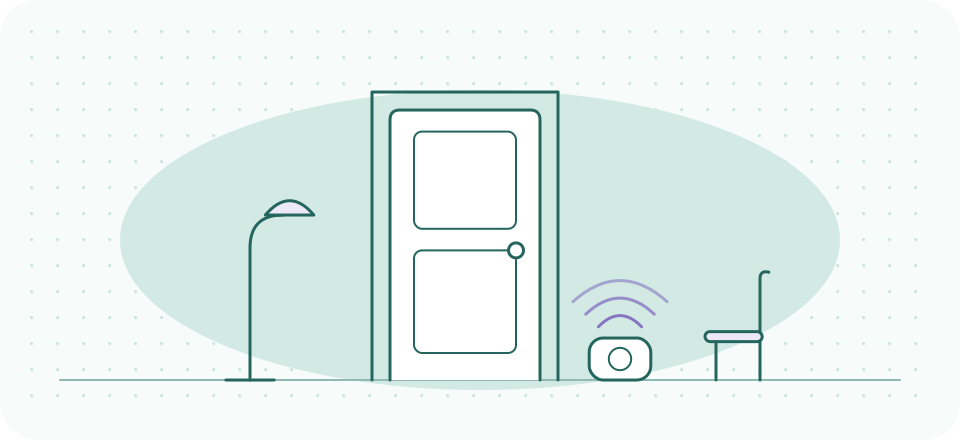
Nobody teaches it, exactly. You do your placement in a suite where a small white box hisses outside each door, and some years later you have your own room and you buy one, and if anyone asked why you would say something about confidentiality and be a little surprised by the question. That is how the strongest customs propagate: not as rules but as furniture.
We think the masking machine is a good custom. This essay argues for taking it seriously enough to say what it is — which turns out to be a more useful exercise than either defending it or debunking it.
The frame, stated once: masking noise is practice management. It is a widely observed professional habit, not a clinical standard and not a regulatory requirement we know of, and running a noise source does not by itself discharge any obligation of confidentiality. Nothing here is medical, legal, or compliance advice.
The thing it is not
Start with the deflation, because it clears the ground. A masking machine does not soundproof anything. It adds sound rather than stopping sound. The speech leaving your room leaves at exactly the volume it always did; every syllable still arrives at the waiting-room chair.
What changes is whether those syllables can be assembled into words. Masking works on the listener, not the wall — it raises the noise floor where a person is sitting so that the speech arriving there sits beneath it, audible as murmur and unrecoverable as content. That is the entire mechanism, and understanding it is the difference between a masking setup that works and one that is decorative.
The decorative kind is common, and it has a signature: the machine is inside the therapy room. We suspect this happens because the device feels like it belongs to the confidential space, the way a lamp or a tissue box does. But a noise source inside the room raises the floor for the two people who most need to hear each other, degrades the telehealth microphone, and does nothing whatsoever for the person in the corridor. It is confidentiality theatre performed for the wrong audience. The noise belongs where the listener is.
What the custom is actually for
Here is where taking it seriously pays. Ask what the machine is protecting against and you get at least three different answers, which want three different setups.
The incidental overhearing of content. The classic: a client in the waiting room catching a phrase through the door. This is what masking is genuinely good at, and it is well handled by a modest noise floor placed between door and chair.
The overhearing of identity. Subtler and often more consequential. A waiting client does not need to make out a sentence to recognise a voice, and in a small community that recognition is the disclosure. Masking helps here too, but so do things that have nothing to do with sound — the scheduling gap that keeps two clients from overlapping, the exit that is not the entrance.
The felt sense of privacy. The one nobody lists and everybody relies on. A person waiting to say difficult things is calibrating, continuously and mostly below awareness, whether this is a place where difficult things stay put. A soft acoustic floor in a waiting room is a signal in that calculation, and so is silence where you can hear a voice but not the words. This is not a technical function and we are not going to dress it up as one, but it is real, and it is probably why the custom spread so completely through a profession that rarely adopts furniture by accident.
Notice that the third reason is the only one that survives the observation that determined listening defeats masking entirely. Someone with an ear against the door is a lease problem, not a noise problem. The custom was never about adversaries.
- The incidental overhearing of contentwhat masking is genuinely good at
- The overhearing of identitymasking helps; so do scheduling gaps and a separate exit
- The felt sense of privacythe one that survives determined listening
Determined listening defeats masking entirely; only the third reason survives that.
The part that troubles us
Here is the honest worry, and it is the reason this essay exists rather than just the guide.
An inherited custom that is never examined tends to drift toward being a substitute for the thing it once supplemented. The machine is on, so the door has been handled. But the machine is the cheapest layer and usually the weakest one. A door that actually latches does more. A schedule that keeps the corridor empty at session boundaries does more. A five-minute conversation with the suite next door about where they take phone calls does more, and costs nothing, and almost nobody has it — partly, we suspect, because the hiss in the hallway has already made the problem feel addressed.
The same drift shows up in telehealth, where the custom has migrated without being re-examined. A therapist working from a spare bedroom buys the machine because that is what the office had, places it inside the room because the corridor is now a hallway with family in it, and ends up with a slightly noisier session and a household that can still hear everything. Meanwhile the single highest-value privacy move in home practice — never putting the client's voice on open speakers — costs nothing and is not part of the inherited custom at all, because in a physical office it was never necessary. We wrote the home sound-privacy guide mostly around that gap.
What examining it gets you
Not abandonment. We run through the setup properly in the masking guide, and the short version is that the custom survives examination easily: place the source between door and listener, calibrate it against a real voice at real session volume, keep it boring and permanent so its presence never signals which hours are in session, and re-test when anything about the room changes.
What examination gets you is proportion. Masking becomes one layer among several instead of the layer, which frees attention for the cheaper and stronger moves sitting next to it. And it gets you the ability to say what you are doing and why — to a suite-mate, to a supervisee, to a client who asks about the hissing box, and to yourself when you are deciding whether the thing that has been running unchanged for four years is still calibrated for the room it is in.
That is the whole argument. Good customs do not need to be protected from being stated clearly. The ones that do were never doing the work.