Sound privacy
Sound masking for therapy offices, done honestly
Walk down the corridor of almost any counseling suite and you will hear it: a soft hiss outside each door, sometimes from a small unit on the floor, sometimes from a speaker no one has looked at in years. The white-noise-outside-the-door arrangement is one of the most widely observed customs in private practice — and one of the least examined. This guide covers what masking actually does, what it cannot do, and how practices that take it seriously set it up.
Frame this correctly: masking noise is practice management — a custom practices have adopted because it serves the feel and function of a confidential space. It is not a clinical standard, not a regulatory requirement we know of, and running a masking source does not by itself discharge any confidentiality obligation. Nothing on this page is medical, legal, or compliance advice. (We argued the point at more length in the essay that started this site's blog.)
What masking actually is
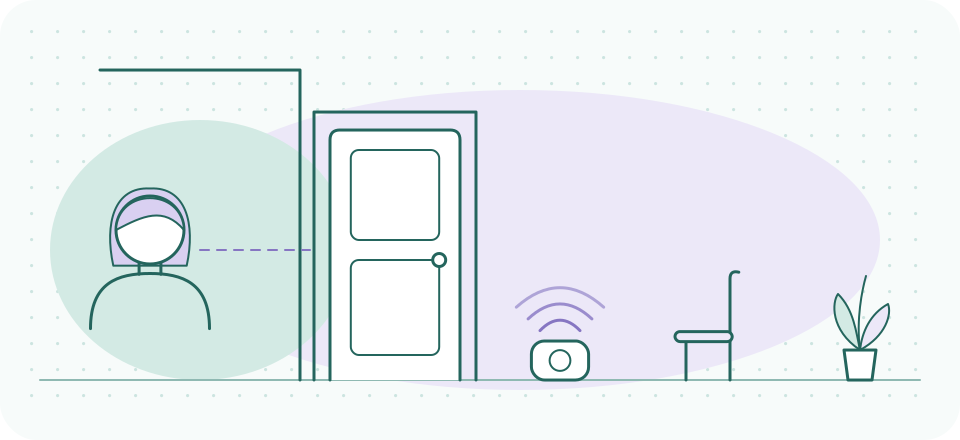
Masking does not block sound, absorb it, or cancel it. It works on the listener, not the wall: by raising the ambient sound level in the space where an eavesdropper (intentional or accidental) would be sitting, it buries the intelligibility of speech leaking through the door. The syllables still arrive — they just arrive beneath a floor of broadband noise, and a voice you can hear but cannot parse is, for privacy purposes, mostly handled.
That mechanism has three immediate consequences that most masking setups ignore:
- The noise belongs outside the door, not inside the room. The classic mistake is running the source inside the therapy room, where it makes the session harder to hear — including on the telehealth microphone — while doing nothing for the person in the waiting area. The masking goes where the listener is: the waiting room, the shared corridor, outside the door.
- It protects against incidental overhearing, not determined listening. Masking raises the effort required to make out words. Someone with an ear literally against the door is a door problem and a lease problem, not a noise problem.
- Level matters more than source. Too quiet and the speech floats above it; loud enough to work and it becomes a presence of its own that some people find grating. The practical calibration used by careful practices: stand where a waiting client would sit, have a colleague speak at session volume inside the room, and adjust until the voice is audible only as a murmur with no recoverable words.
Outside the door, where the listener is
The classic mistake
Masking works on the listener, not the wall: the syllables still arrive, beneath a floor of broadband noise.
What to use as the source
Less than the category's folklore suggests. Broadband noise with energy across the speech range is what does the work — steady, unstructured, boring. Practices run everything from purpose-built masking units to a looping app on a spare tablet to an ordinary fan, and the fan is not the embarrassing option it sounds like — broadband, steady, unstructured is the whole specification. We do not review or recommend hardware — SessionSound is a software-and-practice site — and the truthful reason is that at waiting-room volumes, source quality is rarely the binding constraint. Placement and level are. Spend your attention there.
Two source notes worth having: looping audio with an audible seam (a "breathing" loop) draws attention to itself in a way genuine broadband noise does not, so if you use an app, use one that generates rather than loops. And music is a poor masker — its structure invites the ear in rather than boring it away, and lyrics compete with exactly the frequencies you are trying to bury.
The telehealth twist
Masking was invented for physical waiting rooms, but the custom translates to remote practice in two directions that get missed.
Your side: if you see clients from an office with a shared wall or door, the masking source outside your door protects the session from the corridor exactly as it would in a traditional suite — with one software interaction worth knowing. Noise suppression on your microphone (built-in or a layer like Krisp) will treat any masking hiss that leaks into your room as noise and remove it from your outgoing audio. That is the correct division of labor: software cleans the call, masking protects the corridor. Neither substitutes for the other, a point we develop in the core audio guide.
Your client's side: a client taking sessions in a shared apartment has a waiting-room problem of their own — the household is the corridor. Some providers include a gentle note about sound privacy in their telehealth onboarding: a private room where possible, earbuds so at least your half of the conversation stays off the speaker, and yes, a noise source outside their own door if privacy at home is a live concern. Our home sound-privacy guide covers the provider-side version of the same problem in full.
Setting it up in an hour
- Map the listeners. Where could a session be overheard from? Waiting area, corridor, adjacent office, reception. Masking is placed for those positions — not for the room.
- Place the source between door and listener. Directly outside the therapy-room door is the default for a reason: that is where the leakage comes out, and noise placed at the leak covers every listening position beyond it at once.
- Calibrate with a real voice. Colleague inside at conversational volume; you in the client seat. Raise the masking until words are unrecoverable, then stop. If the level it takes feels oppressive, the door or wall is too leaky for masking alone — that is a physical problem outside our scope, and worth knowing rather than papering over.
- Make it boring and permanent. On before the first session, off after the last, same level daily. A masking source that comes and goes announces exactly the thing it exists to obscure — which sessions are in progress.
- Re-test when anything changes. New suite neighbor, rearranged waiting room, a door replaced: five minutes with a colleague re-runs the calibration.
Colleague inside at conversational volume; you in the client seat. The level is found, not guessed.
What masking is not
A short list that keeps practices honest. Masking is not soundproofing — it adds sound rather than stopping it, and a sufficiently loud session will outrun it. It is not a compliance artifact — we know of no rule that requires it, and none that a hissing speaker satisfies on its own. And it is not a substitute for the conversation with your own suite about corridors and scheduling, which costs nothing and often does more. The custom earns its place as one layer among several: a door that latches, a schedule that keeps the corridor empty at session boundaries, software that keeps the call clean, and a soft floor of noise where a listener might sit.
- A door that latches
- A schedule that keeps the corridor empty at session boundaries
- Software that keeps the call clean
- A soft floor of noise where a listener might sit
Masking earns its place as the fourth of these, not as a substitute for the other three.
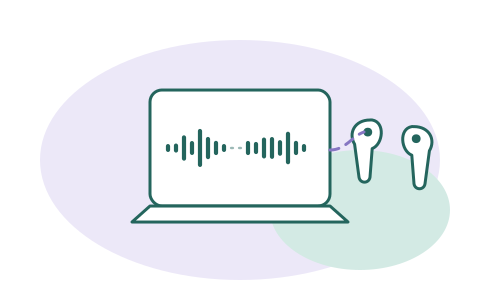
Masking guards the corridor. This guards the call.
The other half of session sound privacy is what leaves your microphone. Krisp strips the corridor, the household, and the masking hiss itself from your outgoing audio, with noise-suppression processing done on your device (per Krisp's security documentation, read 2026-09-20). 7-day free trial; Core from $8/month billed annually.
A referral link, said plainly: if a Krisp subscription starts from this button, Krisp may pay SessionSound, and what you pay stays the same. Everything else on this page — placement, calibration, the custom itself — costs nothing and pays us nothing.