Between Sessions · essay
What your client actually hears
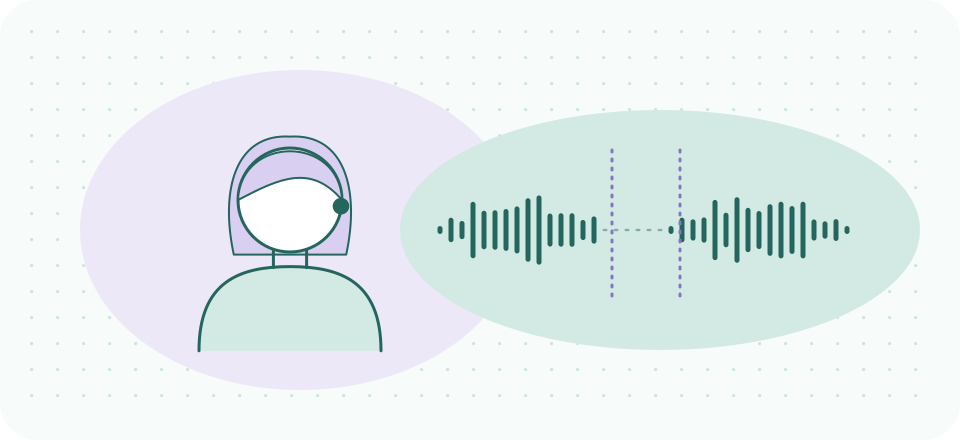
There is an asymmetry at the centre of remote practice that almost nobody names. You spend fifty minutes attending very closely to how your client sounds — that is the work — and you spend essentially none of it knowing how you sound to them. The incoming channel is under continuous expert observation. The outgoing channel is unmonitored, and has been since the day you set it up.
This essay is about what changes if you spend ten minutes on the direction you cannot hear.
The feedback loop that does not exist
In a physical room, audio corrects itself. You hear your own voice in the space, you register a client leaning in, you adjust without deciding to. The room hands you a continuous signal about how you are landing.
On a video call every one of those signals is severed. Your voice reaches you by bone conduction, not through the microphone. The client's small compensations — the lean, the slight frown of effort — arrive as low-resolution video, on a delay, and read as engagement rather than strain. And crucially, a client who is struggling to hear you will very often not say so. There are ordinary reasons for that: the interaction is asymmetric, they are not there to manage your technology, and mentioning it costs a piece of the hour they came for. Whatever the reason, the practical consequence is the same. Silence about your audio is not evidence that your audio is fine.
So the loop has to be closed deliberately, from outside sessions, or it does not get closed at all.
Ten minutes, once
Record yourself through the actual chain — same microphone, same platform-adjacent path, same room, same time of day — and then listen to it on earbuds, which is what a good proportion of your caseload is using. Most platforms will let you record a call with yourself; a plain voice memo captured through the same microphone gets you most of the way. Do not perform. Say a few sentences the way you speak in the fourth minute of a session, including a pause and the sentence that follows it.
Then listen for four specific things, because unstructured listening will just make you dislike your own voice, which is universal and not useful.
- Room, or no room. Does your voice sound like it is in a box a metre away, or is it close and present? Distance and reverb are what a laptop microphone at arm's length produces, and they are the single biggest difference between effortful and effortless listening. If you hear the room, move the microphone; it is the highest-yield change available and it costs nothing.
- The first word after the pause. This is the session-specific one. Play the silence and the sentence after it. Is the first syllable there, whole? If it arrives clipped or fading-in, something in your chain is gating — and it is doing that to every sentence you say after a long silence, which is to say the sentences that matter most. The fix is usually fewer processing layers rather than more, which we work through in the triage guide.
- What else is in the recording. Not what you can filter — what is there. The refrigerator, the road, the upstairs floorboards, your own chair. You have long since stopped hearing these and your client has not, because for them these sounds are novel and unexplained, arriving from a place they cannot see.
- Your level relative to the pauses. If your voice is only a little louder than the background, your client is doing separation work all hour, and fatigue from that is indistinguishable, from the inside, from the ordinary fatigue of a hard session.
There, whole
Clipped or fading in: something is gating
Play the silence and the sentence after it: is the first syllable there, whole?
The part that is about more than quality
One consequence of this exercise tends to land harder than the others, so we will make it explicit.
Everything audible in your recording is information about you that your client receives whether or not you intended to send it. Not in a sinister sense — in the ordinary sense that sound carries context. Whether you are at home. Whether someone else is there. What kind of building you are in. Whether this hour is happening in a room set aside for it or in a corner of a life. Clients are people, and people infer constantly from exactly this kind of material.
We are not going to tell you what any of that means for a therapeutic relationship, because that is clinical territory and we are a technology desk. The technology observation is narrow and worth having anyway: the ambient content of your outgoing audio is a channel you are broadcasting on, and until you listen to a recording you do not know what you are broadcasting. Some providers, on hearing theirs, decide they are happy with it. Some change the room. Both are informed positions, and neither is available to someone who has never heard the tape.
The reciprocal, handled gently
The same asymmetry runs the other way, and it deserves a lighter touch. Your client also cannot hear how they sound to you, and unlike you they have no professional reason to care — which is why the advice here is to fold one or two expectations into the onboarding material you already send rather than to ever troubleshoot a client's setup live. A phone propped rather than held. Earbuds if they have them. A private room if one exists, which serves their sound privacy as much as your audio. Framed as "so that I can hear you properly," it reads as care, because it is.
And then let it go. The client's side will sometimes be bad and no amount of onboarding will fix the fact that someone is calling from a parked car. Your side is the half you control, and it is the half that has been running unexamined since the day you set it up.
Put it on the calendar
The reason this is an essay and not a checklist item is that it is not a routine — it is a one-off with a long half-life. Record, listen, fix what the recording shows, and then do not think about it again until something changes: a new room, a new machine, an operating-system update that quietly reselected your microphone. Twice a year is generous. Once, ever, is infinitely better than the status quo, which for most remote practices is never.
The two-minute pre-session check keeps a good setup good. This is the ten minutes that tells you whether the setup was good in the first place.