Sound privacy
Sound privacy when you see clients from home
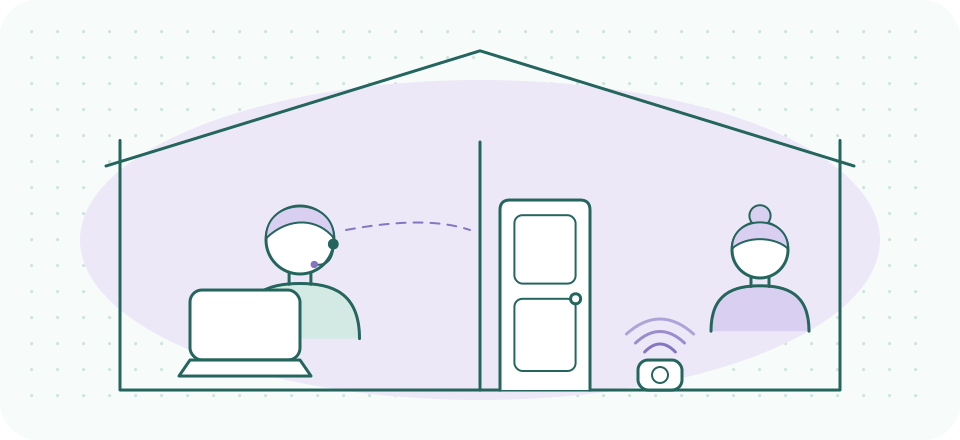
A home-based practice quietly reverses the geometry of the office. In a suite, the confidential space is yours and the public space belongs to strangers; at home, the space outside the session belongs to the people you live with — which makes the sound-privacy problem more intimate, not less. Your household should not hear your clients. Your clients should not hear your household. And both problems have to be solved in a building that was never designed for either.
This guide is the home-practice companion to our office masking guide: the same honesty about what works, applied to spare bedrooms, apartments, and houses with school-age acoustics. As everywhere on this site, it is technology and practice-custom guidance — never medical, legal, or compliance advice.
Direction one: keeping the session in the room
Direction two: keeping the household out of the session
Suppression removes sound from the call, not from your own ears — which is why timing carries the rest.
Direction one: keeping the session in the room
Start with the direction your professional obligations care about most — what leaves the room.
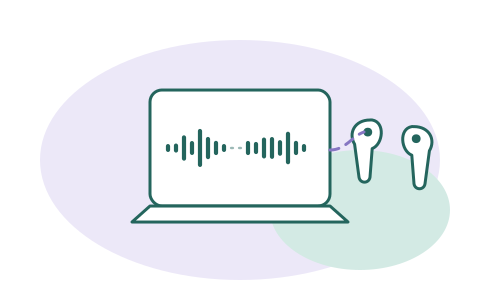
Your voice is the leak. On a telehealth call, only your half of the conversation exists in the air of your home; the client's voice can be confined to your ears entirely. Do that first: route the client's audio to earbuds or headphones, always. Open speakers in a home office broadcast the client's side to anyone near the door, and no downstream custom fully repairs that choice. This single habit — client audio never on speakers — is the home equivalent of the office's white-noise unit, and it costs nothing.
For your half, the office custom translates directly. A broadband noise source outside the session-room door raises the ambient floor where a household member would be passing, burying the intelligibility of what filters through. Everything in the masking guide applies — level calibrated against a real voice, source that generates rather than loops, running on a schedule so its presence doesn't announce session boundaries. In an apartment, the corridor outside your own front door is usually beyond your control; the interior hallway is not, and interior doors are where most household overhearing happens.
Then lower the source volume itself. The quieter you can comfortably speak, the less there is to mask. A close microphone is the enabling technology here: with the mic near your mouth, your conversational level can drop well below open-room projection while your client hears you at full clarity — placement details in the core guide. It is worth noticing whether you have been unconsciously projecting for a distant laptop microphone — and projecting straight through your own walls while you did it.
Direction two: keeping the household out of the session
The reverse direction is a quality problem and a dignity problem at once — a client mid-disclosure should not compete with a blender.
Software carries most of this load now. Your platform's built-in noise reduction will handle steady background sound; a dedicated on-device layer like Krisp handles the harder cases — the intermittent, the human, the doorbell — and strips them from your outgoing audio before the platform sees it. Our full assessment covers where it earns its subscription in a home practice (short version: households are its core case) and where built-ins suffice.
Timing carries the rest. Suppression removes sound from the call, not from your own ears — you will still hear the household through the door, and it will still land on your attention. The customs that help are boring and effective: session hours the household actually knows about, a visible in-session signal (any indicator on the door beats an open question), deliveries pointed away from session hours, and the noisiest appliances run between blocks. None of this is audio engineering; all of it shows up in how sessions feel.
The apartment problem, named honestly
Thin party walls put a neighbor on the other side of your confidential space, and you cannot install customs in their living room. Three honest observations, offered as reasoning rather than measurement — we run no acoustic tests and will not pretend otherwise. First, the variable you actually control is your own volume: speech at a normal indoor level has far less chance of arriving next door as recoverable words than speech projected across a room, and the close-mic habit above is what lets you stay at the lower level without your client losing you. Second, masking works on your side of the wall too: a noise floor in your own session room slightly above silence (a quiet fan-level, well below anything your microphone's suppression can't remove from the call) denies a quiet backdrop against which intruding or escaping speech would stand out. Third, if a specific wall genuinely worries you, position yourself speaking away from it — direction matters more than most acoustic folklore admits. Beyond that lies physical treatment, which is outside what we cover.
The household is not the enemy of the practice
A last word that belongs in a technology guide precisely because no technology fixes it: the home practices that sound most private are the ones where the household was told what the stakes are. A partner who understands that the murmur behind the door is someone's hardest hour treats the hallway differently than one who was simply asked for quiet. The tools on this page — earbuds, close mics, suppression layers, a hiss outside the door — work noticeably better inside that understanding than as a substitute for it.
The home setup, in five moves
- Client audio to earbuds, never speakers. The client's voice should exist only between your ears. Non-negotiable, free, done today.
- Close microphone, quieter voice. Mic within 30 cm; let your speaking level drop to match. Less projection, less leakage, better call audio — one move, three wins.
- Suppression on your outgoing audio. Built-in first; an on-device layer like Krisp if your household is a working one. Try the free trial against a real week.
- Masking outside the session door. Calibrate against a real voice at your speaking level, per the masking guide. Interior doors are the battleground.
- Customs the household knows. Posted hours, an in-session signal, loud tasks between blocks. The cheapest layer and the one clients can hear the absence of.
The household case is Krisp's home game
Doorbells, dishes, other people's meetings — stripped from your outgoing audio on-device, before your platform hears them. Checked 2026-09-20: 7-day free trial, Core at $8/month billed annually or $16 monthly.
Run the free trial through a real week
A referral link, said plainly: if a Krisp subscription starts from this button, Krisp may pay SessionSound, and what you pay stays the same. Moves 1, 2, 4, and 5 above cost nothing and pay us nothing — do those regardless.